
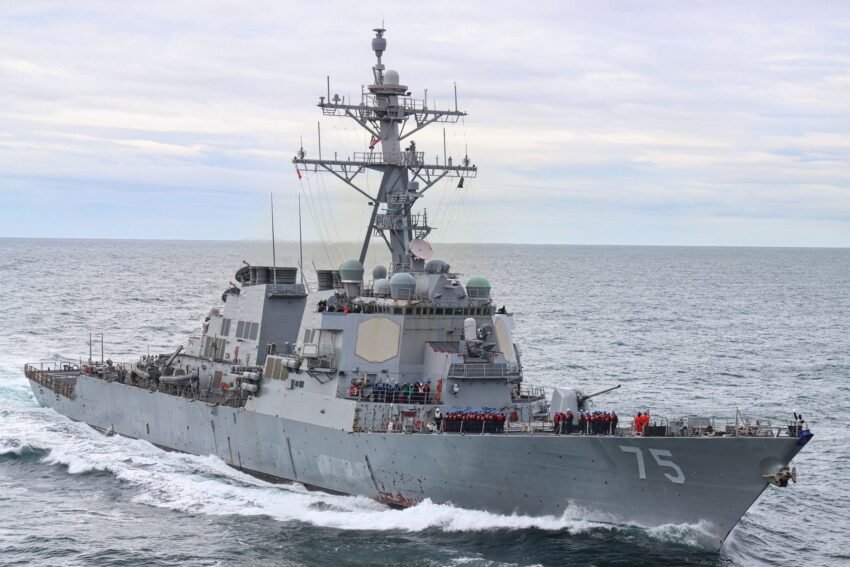
Lyntris Inc. (NYSE: LYNX) has completed qualification of a constrained hardware assembly for Raytheon’s SPY-6 naval-radar family, adding a manufacturing source that the company said is intended to reduce a supply-chain risk as the U.S. Navy’s radar program moves into higher-rate production. The work concerns a small but essential part of the radar’s electronics packaging, not a new radar system or a disclosed production order.
The milestone matters because SPY-6 is the radar family the Navy is fielding across destroyers, carriers, amphibious ships and frigates. The modular system is built from common radar-array blocks and supports detection and tracking against air, surface, ballistic-missile and electronic-warfare threats. A delay in a component that secures and cools those electronics can become a production constraint even when the larger radar architecture is ready.
Lyntris worked with Raytheon, an RTX (NYSE: RTX) business, for nearly two years to qualify wedgelock assemblies used in the chassis of the Radar Modular Assembly, the company said. Wedgelocks secure electronic components inside the thermally managed array chassis and help transfer heat away from high-power electronics. The company said it established manufacturing processes, validated performance and qualified the assemblies against Navy requirements after identifying them as a potential limit on full-rate production.
The underlying issue is familiar to government program managers: a complex platform can depend on parts that receive far less attention than its sensors, software or weapons interfaces. Lyntris said the component requires precision manufacturing, controlled assembly and access to specified raw materials, conditions that had contributed to long lead times in the supplier base. The company built manufacturing and test capability in California and Nevada for the broader radar chassis work, then applied that capability to the wedgelock assembly.
For the Navy, the immediate value is supply-chain resilience rather than a change in radar performance. SPY-6 uses a common building-block approach across several ship classes, so a qualified source for a shared component could help program teams avoid a single bottleneck as builds increase. The company did not disclose expected unit volumes, contract value, delivery dates or the number of assemblies it expects to produce.
The qualification also does not guarantee an order. Lyntris said its future production depends on Navy demand, program schedules, appropriations, qualification standards and continuing orders from Raytheon. Those constraints matter in defense procurement, where a supplier can complete technical validation yet still face timing changes in shipbuilding plans or production budgets.
This is an actual defense-program application rather than a hypothetical government use case: Lyntris’ work supports the Navy radar family now being fielded across the surface fleet, according to the company. For a program office or prime contractor, the practical question is whether the newly qualified process can maintain quality and throughput as production scales, while preserving the thermal and environmental reliability required in maritime service.
The broader significance is less about one chassis fitting than about how defense electronics programs manage industrial capacity. Rather than replacing a legacy radar or introducing a new sensor, the qualification targets a specific long-lead dependency in an established Navy program. If Lyntris can scale the process as claimed, it would give the SPY-6 supply chain another production path; if demand, funding or quality targets shift, the milestone alone will not resolve those risks.