
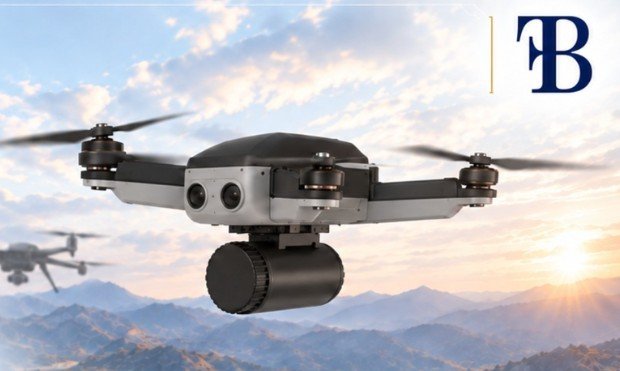
First Breach (NASDAQ: FBDT) says its proprietary drone prototype has completed its first autonomous flight, executing takeoff, a predetermined satellite-navigation route, return and landing without manual flight inputs. The test is an early technical milestone for an aircraft the Hagerstown, Maryland, company says it is developing for military, law-enforcement and commercial markets.
The announcement describes a preplanned navigation mission, rather than a disclosure of autonomous target recognition, obstacle avoidance, operation in a GPS-denied environment or a fielded government capability. First Breach did not identify customers, contracts, pricing, deployments or independent flight-test results. Those distinctions matter for agencies evaluating whether a small unmanned aircraft can meet a particular mission, airworthiness, communications-security and procurement requirement.
For the test, the company used Betaflight flight-control software and said the result validated the prototype’s guidance, navigation and control loop. First Breach is also moving the flight stack to PX4, an open-source autopilot platform used for unmanned vehicles. The company said that work is intended to add mission-planning, failsafe and sensor-integration capabilities, but it did not release a timeline or test data for the PX4 implementation.
The proof-of-concept is a four-rotor, Class 1 aircraft with an all-up weight of about 2.2 kilograms and a stated payload capacity of 500 grams. First Breach said the airframe includes a Picatinny rail and electrical interface for payloads. Its listed specifications include a 2-kilometer effective range, 10 minutes of endurance, a cruise speed of 50 kilometers per hour and a maximum speed of 120 kilometers per hour. The company said those specifications are subject to change as development continues.
The prototype uses GNSS navigation with visual-inertial augmentation and a 900 MHz MAVLink control link, according to the announcement. It is powered by lithium-polymer batteries and can be assembled in less than 10 minutes, the company said. Publicly available information does not establish how the system performs with a specific payload, in congested radio-frequency environments, under adverse weather conditions or against the cybersecurity and sustainment standards that a government buyer may require.
For defense and public-safety organizations, a small aircraft of this type could be considered for missions such as short-range reconnaissance, site inspection, scene assessment or search support. Those are potential use cases, not disclosed deployments. Adoption would still depend on flight performance, secure control and data links, operator training, aviation rules, privacy requirements, acquisition authority and the availability of maintenance and replacement parts.
First Breach is developing the platform under an agreement with Hellbender Inc., which is providing engineering, design, technical support and component-manufacturing services. The company said it plans to complete initial prototypes in the fourth quarter of 2026, begin scaled production in the second quarter of 2027 and eventually reach production of more than 2,500 drones per week. Those are company targets rather than current manufacturing output.