
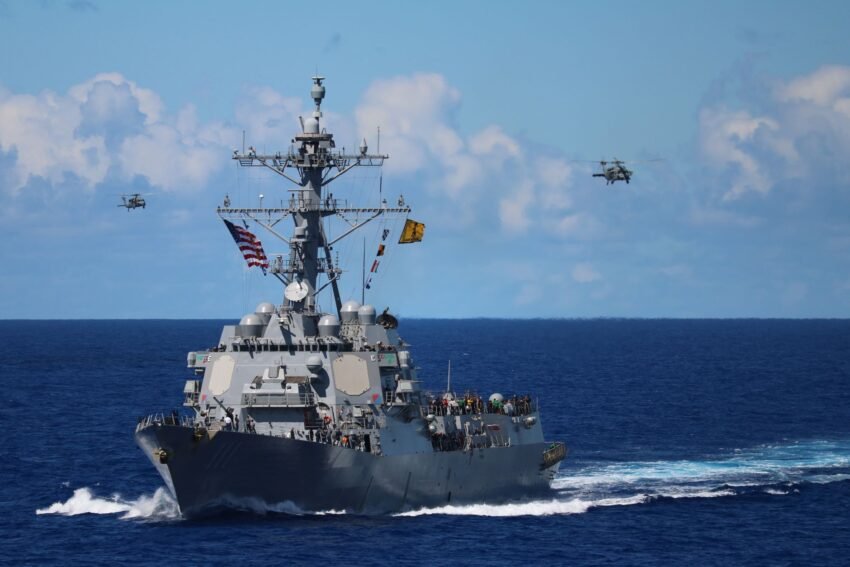
Leonardo DRS has won a contract to provide the electric propulsion system for the Republic of Korea Navy’s KDDX destroyer program, a planned class of next-generation guided-missile destroyers. The company will work with Doosan Enerbility on the integrated power and propulsion system for the lead ship, which Hanwha Ocean is building. The award puts DRS’s electric-drive technology into a program that South Korea expects to produce at least six ships.
The work matters because a modern warship’s power system does more than turn propellers. Sensors, electronic-warfare equipment, weapons systems, unmanned-vehicle charging and other onboard capabilities all place demands on the ship’s electrical architecture. Leonardo DRS said the KDDX program is expected to introduce the Republic of Korea Navy’s first full-electric-drive surface combatants, a design approach intended to provide propulsion while supporting increasingly power-intensive mission systems.
Under the contract, DRS will supply its 100-Series permanent-magnet propulsion motors and compact variable-frequency drives. The company said the equipment will form an integrated electric power and propulsion solution, with electrical and mechanical components extending from the prime movers to the propellers. A variable-frequency drive controls the electrical power sent to a motor, allowing the propulsion system to adjust its output. DRS said its paired motor-and-drive approach is intended to provide efficient propulsion control in a compact configuration.
The company described the permanent-magnet motor design as high-torque-density technology. It said that compact architecture can reduce size and weight compared with conventional electric machines, while the drives help reduce the engine-room footprint and give ship designers greater flexibility. Such claims are from DRS; the announcement did not disclose performance measurements, contract value, delivery dates or the final configuration of the KDDX power system.
The KDDX program is significant because it is South Korea’s first indigenously designed and built destroyer program, according to DRS. The planned ships are intended to meet multi-mission requirements for a blue-water fleet. DRS said the systems it will provide are designed to meet applicable military requirements for power quality, shock and vibration, as well as Republic of Korea Navy operational requirements.
DRS also said the system is meant to leave capacity for advanced radars, electronic-warfare systems, directed-energy systems, unmanned-vehicle charging and drone-swarm launches. The company did not say which of those capabilities will be installed on the KDDX vessels. The point is architectural: an electric power system has to be sized and managed not only for propulsion but also for future loads that a conventional ship design may not have anticipated.
One potential application would be a naval program evaluating how to add a new sensor or unmanned-system support capability without redesigning the core propulsion plant. An integrated electric-drive architecture could be assessed as part of that tradeoff alongside space, weight, cooling, reliability and maintenance requirements. This is an illustrative use case, not a disclosed KDDX mission requirement.
For defense technology and acquisition leaders, the contract is a reminder that platform modernization increasingly depends on the power infrastructure beneath the visible mission equipment. The KDDX award does not establish the operational performance of the finished ships, and much of the program remains to be delivered. It does, however, place compact permanent-magnet motors and variable-frequency drives at the center of a next-generation naval program designed to accommodate a broader electrical load.