
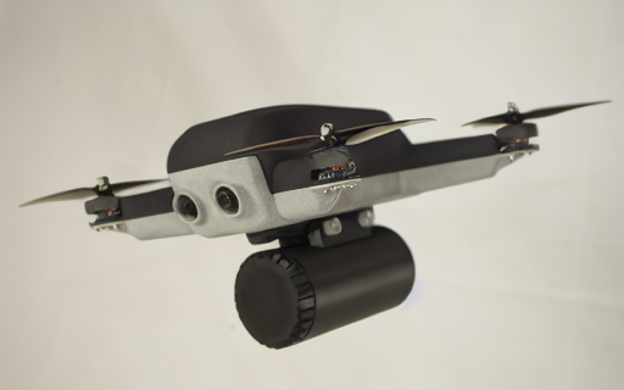
First Breach (Nasdaq: FBDT) has completed an untethered flight of a proprietary drone prototype, a step toward a U.S.-made platform the Hagerstown, Maryland, company is developing for commercial, law-enforcement and military markets. The flight moves the program beyond tethered testing, but the aircraft remains a prototype and has not yet completed integrated controller testing or entered production.
For government buyers, the significance is potential domestic capacity in a market where agencies are expanding their use of small unmanned aircraft for defense, public safety, inspection and emergency operations while scrutinizing supply chains. First Breach said it plans to complete initial prototypes in the fourth quarter of 2026 and begin scaling production in the second quarter of 2027, with a target capacity of more than 2,500 drones a week. Those are company targets, not current output or a disclosed government procurement commitment.
The aircraft flew using commercial flight electronics while First Breach develops a proprietary flight controller with Hellbender, a Pittsburgh engineering and advanced-manufacturing company. First Breach said the controller board is operating with Betaflight open-source flight-control firmware. The next development step is to install that controller in the aircraft and evaluate the combined system in further flight testing.
That distinction matters. An airframe, propulsion system and basic vehicle electronics can be evaluated independently, but a deployable system must show that its navigation, control link, flight-control hardware and mission equipment work together reliably. First Breach did not identify government customers, contracts, price, sensor configuration or a production-ready configuration for the platform.
The current proof-of-concept is a four-rotor Class 1 aircraft weighing about 2.2 kilograms with an estimated payload capacity of roughly 500 grams. It uses GNSS navigation with visual-inertial augmentation and a 900 MHz MAVLink control link, according to the company. First Breach reported a demonstrated 2-kilometer range, about 10 minutes of endurance, a cruise speed of 50 kilometers per hour and a maximum speed of 120 kilometers per hour. The stated specifications remain subject to change before production.
Demand for government drone capability is high across both military and civilian missions. The Defense Department’s Replicator initiative was established to field autonomous systems at a scale of multiple thousands, while Replicator 2 focuses on countering small aerial-system threats at critical installations and force-protection sites. Those initiatives point to a need not only for aircraft but also for a domestic industrial base able to manufacture and sustain them at volume.
Civil agencies have parallel needs. The Department of the Interior’s UAS program uses government-owned and commercially contracted aircraft for missions where unmanned systems can improve science, safety or operating costs compared with crewed aviation. The Justice Department also updated its UAS policy in 2025, setting updated rules for department components using drones. One potential application for a small aircraft of this class would be post-disaster assessment, perimeter inspection or search support, provided it meets an agency’s airworthiness, security, privacy and procurement requirements. This is an illustrative use case, not a disclosed deployment.
First Breach owns the platform intellectual property and plans to control manufacturing and commercialization, while Hellbender provides engineering, design, technical support and component manufacturing. “Our work together is helping turn that vision into reality,” Hellbender Chief Revenue Officer Brett Phillips said.
For technology and acquisition leaders, the untethered flight is a credible but early engineering milestone. The program’s practical value will depend on successful controller integration, flight and payload testing, manufacturing consistency, cybersecurity and the ability to meet procurement requirements. As agencies look for scalable unmanned systems from domestic suppliers, the unanswered questions around performance, sustainment and production readiness will matter as much as the initial flight.