
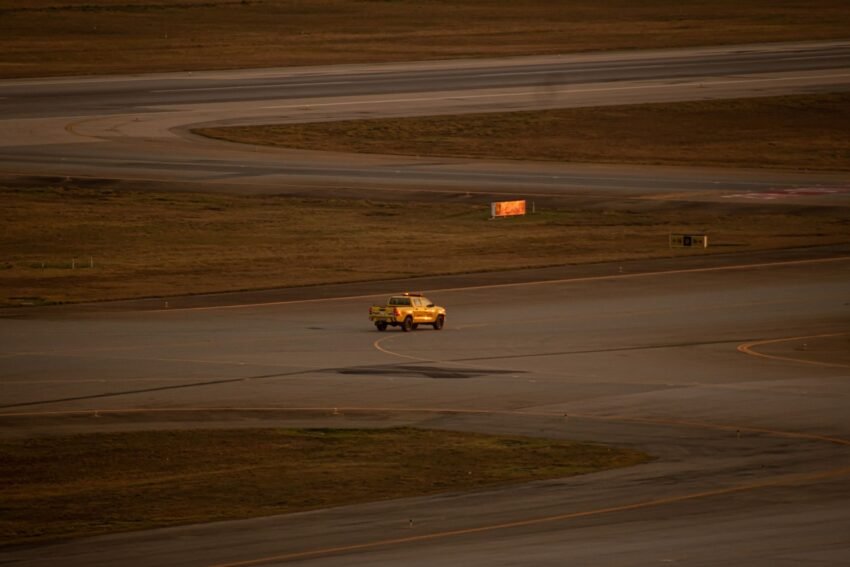
Safe Pro Group Inc. (Nasdaq: SPAI) has completed a U.S. Air Force-funded research phase to build an artificial-intelligence dataset for detecting foreign object debris at airfields. The work is an early but consequential step toward using computer vision to find small hazards on runways and operating areas before they disrupt flight operations or damage equipment.
Safe Pro said it finished all research milestones under a previously awarded Phase I Small Business Innovation Research contract from AFWERX, the Department of the Air Force innovation arm. The project used imagery of foreign object debris, or FOD, encountered at U.S. Air Force and civilian airfields. The company said it demonstrated its SpotlightAI computer-vision technology for small-object detection, collected and analyzed high-resolution imagery, and prepared technical reports.
The milestone does not mean the Air Force has adopted the technology for routine use. Safe Pro did not disclose the contract value, a detection-accuracy rate, how many images were collected, the airfields involved or whether the data has been incorporated into an operational system. Any follow-on SBIR work remains subject to AFWERX review and a future award decision.
That distinction matters for government aviation teams. Foreign objects such as loose hardware, fragments or other debris can create safety and maintenance concerns, while conventional inspection practices can require personnel to visually cover large paved areas. A trained computer-vision model could potentially help prioritize imagery for a human reviewer, but the source does not establish that SpotlightAI can replace existing inspection procedures or meet a particular Air Force safety standard.
Safe Pro’s broader software platform, SPAI Ground Truth, processes drone-based imagery with machine-learning and computer-vision algorithms. The company said the platform was originally developed to identify small threats and objects of interest in high-risk environments, including landmines, unexploded ordnance and drones. For the airfield project, the relevant change is the creation of a FOD-focused dataset, which gives a model examples from a different operational setting than battlefield or post-conflict mapping.
Data quality will be central to whether that work can advance. An airfield system would need imagery covering the visual variation that operators encounter: different pavement surfaces, lighting, weather, aircraft activity, camera heights and object types. It would also need testing that measures false alarms and missed objects, plus a workflow for preserving records and routing a finding to the people responsible for inspection or runway clearance. Safe Pro did not provide those results.
One potential application would be a military installation using approved drone imagery after a storm, construction activity or a busy flying period. Software could flag areas with possible debris for airfield managers to inspect, allowing staff to focus their review rather than treating an automated alert as a final safety determination. This is an illustrative use case, not a deployment identified by Safe Pro or the Air Force.
AFWERX operates at a scale that makes such research milestones notable but not decisive. The organization says it awarded more than 1,000 contracts totaling $1.37 billion in fiscal 2025 and recorded 438 Phase III transitions valued at $8.1 billion. Those figures describe the program overall, not Safe Pro’s project or its chance of progressing beyond Phase I.
For public-sector technology leaders, the completed research offers a specific example of AI work moving from broad security claims toward a defined operational dataset. Compared with manual-only inspection or generic image analysis, a FOD-trained model could eventually give airfield teams a more targeted review tool. Its practical value, however, will depend on independently demonstrated performance, integration with established safety processes and a decision by the Air Force to fund the next stage.