
Long-range strike drones have become an important part of modern warfare because they can extend a small unit’s reach beyond the immediate line of contact while carrying sensors, communications equipment or a mission payload. Their value depends on more than distance: military users also need systems that can be transported easily, operate through disrupted navigation and radio conditions, and be produced at a pace that matches demand.
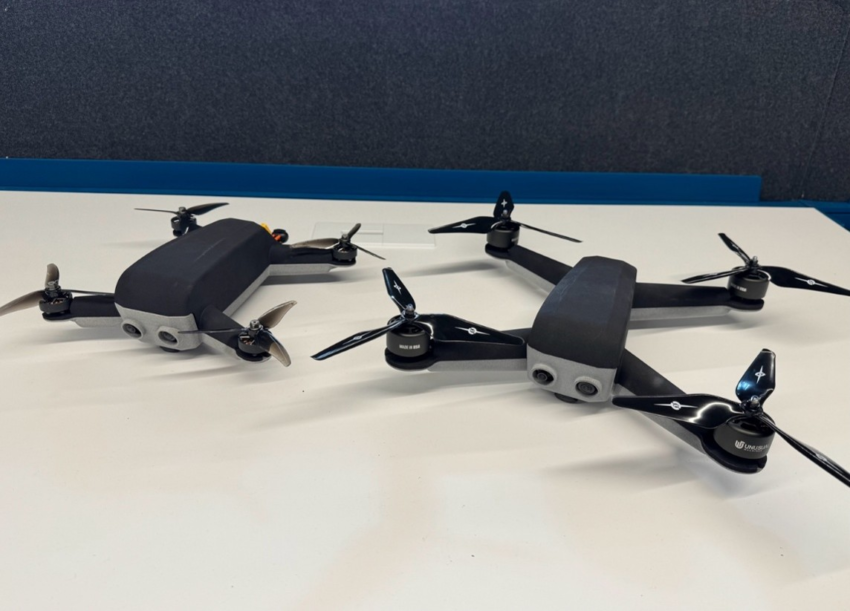
First Breach Inc. (NASDAQ: FBDT) has completed an initial test flight of its Long Range Strike, or LRS, drone platform, the company said. The milestone puts its second proprietary unmanned aircraft into active flight testing alongside the Close Quarters Strike, or CQS, platform, and gives the Maryland defense manufacturer a clearer path toward a shared U.S.-based product line.
The LRS is being developed with Pittsburgh-based Hellbender Inc. as a compact, man-portable Class 1 unmanned aircraft system. First Breach said the aircraft weighs less than 9 kilograms, has propellers shorter than 457 millimeters and a wheelbase or folded wingspan below 350 millimeters. Those dimensions matter for defense organizations that need a system field personnel can move and launch without a large support footprint.
According to the company, the platform is designed for a range greater than 20 kilometers, a current speed of about 120 kilometers per hour and a payload of roughly 1 kilogram. Those are design and current-performance figures, not independently verified operational results. Still, they point to the tradeoffs First Breach is pursuing: a relatively small airframe with enough reach and payload capacity for missions where a crewed aircraft would be impractical or unavailable.
Operators control the LRS in first-person view, with computer-vision search assistance layered over map-based waypoint navigation, First Breach said. The company also said its onboard hardware is intended to support identification friend or foe and terminal guidance. Modular radios and GNSS-denied navigation hardware are planned to help the aircraft retain usable positioning and communications in an electronic-warfare environment, where satellite-navigation signals or conventional links may be degraded.
That emphasis on resilience is central to why long-range drones now matter to defense technology leaders. An unmanned system that works only with a clear satellite signal and uninterrupted radio connection has limited value in a contested environment. A system that can combine operator control, planned waypoints, onboard sensing and alternative navigation methods could give a unit more options, although the company has not released independent test data showing how LRS performs under jamming or other operational stresses.
First Breach said the LRS and CQS share components, a supply chain and a production line. For acquisition and sustainment teams, that approach could simplify parts management, training and manufacturing planning compared with supporting unrelated aircraft designs. The company says its LRS sourcing plan calls for non-Chinese battery packs, motors, power electronics, flight-control systems, flight computers and vision-guidance systems, a supply-chain objective that may be relevant to buyers focused on domestic sourcing and continuity.
One potential application would be a military unit using a compact long-range system to survey a route or area before personnel move forward, then share the resulting situational awareness with a command post. This is an illustrative use case, not a deployment First Breach identified. Actual field use would depend on mission authorization, training, spectrum management, system integration and the aircraft’s demonstrated reliability.
First Breach is targeting completion of initial prototypes in the fourth quarter of 2026 and the start of scaled production in the second quarter of 2027. By bringing both drone designs into flight testing around a common production model, the company is moving toward a domestic unmanned-systems portfolio for evaluation.